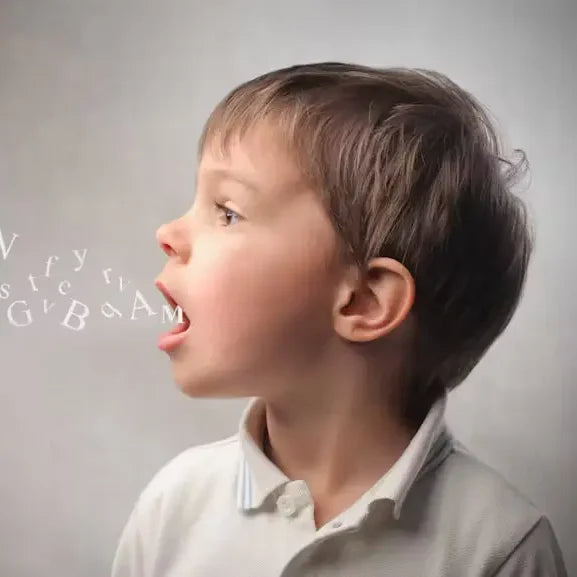
Most parents eagerly await their child’s first words, but few realize that speech development is closely connected to motor development. Speech is not simply about the mouth — it is the result of the coordinated functioning of the entire body, nervous system, and sensory systems.
1. The Development of Speech and Movement Go Hand in Hand
Even in newborns, it can be observed that the maturation of the nervous system simultaneously supports gross motor skills (lifting the head, turning, crawling, climbing) and the development of skills needed for speech. The areas of the brain responsible for controlling movement are connected to the centers responsible for speech and language processing.
This connection is no coincidence: neurological research has shown that direct neural pathways run between the cerebellum, responsible for movement, and Broca's area, responsible for speech. This is why children who move early and often frequently also start speaking sooner. The neural connections that form during movement lay the foundation for the complex coordination required for speech.
2. Crawling and Climbing Support Brain Maturation Processes

According to experts, the cross-coordination that develops during crawling and climbing activates the connection between the two hemispheres of the brain. This integration is essential for complex abilities such as speech comprehension, vocabulary building, and sentence formation.
While developing cross-coordination, the child learns to coordinate the movement of the right and left limbs, which strengthens the corpus callosum, the bridge connecting the brain's two hemispheres. This structure is crucial for language processing, since both hemispheres are actively involved in speech comprehension and production. A lack of crawling and climbing can therefore have a long-term impact on the development of a child's language abilities.
3. The Connection Between Fine Motor Skills and Speech Ability
Many parents are surprised to learn that finger movements and the formation of speech sounds are also intertwined at the neurological level. Modeling clay, drawing, using tweezers, or buttoning not only refine finger dexterity but also strengthen the motor pathways needed for speech.
In the motor cortex of the brain, the control centers for the fingers and the speech organs are located close to one another. The neural pathways activated during fine motor exercises also permeate the areas of speech motorics. This is why it's especially beneficial for children to regularly engage in activities such as bead threading, cutting with scissors, or even making a sandwich. These seemingly simple movements prepare the coordinated motion of the lips, tongue, and jaw, which is essential for clear sound formation.
4. Why Might Speech Be Delayed Without Enough Movement?
Unfortunately, children today often lead a movement-poor lifestyle, which can slow the maturation of the nervous system. If important gross motor experiences (crawling, climbing, swinging) are missing, this can affect the onset of speech and the quality of sound formation.
The consequences of insufficient movement are multifaceted: on one hand, nervous system maturation slows down, and on the other, the variety of sensory experiences that form the basis of speech comprehension is reduced. Too much time spent in sitting activities (baby seats, car seats, high chairs) restricts natural motor development, which can delay the onset of speech. According to research, children who spend at least 2–3 hours a day in active movement say their first words on average 2–3 months earlier.
5. Supporting Speech Through Motor Development Exercises
There are movement therapies specifically designed to support nervous system maturation and the onset of speech. These take place in a playful format under the guidance of a specialist, and are enjoyable for children — while also developing neural connections in the brain.
Sensory integration therapy and neuromotor development are both methods that specifically support the neurological foundations needed for speech. In these therapies, children get acquainted with different textures, balance, and rock back and forth, which stimulates the vestibular system. This system, located in the inner ear, is responsible not only for balance but also for attention and auditory processing, both of which are essential for speech comprehension.
6. Stable Posture Is a Prerequisite for Voice Production
For a child to speak freely, proper posture is essential. Without core muscle stability, the speech organs cannot function optimally either. This is why it's worth paying attention to varied movement from early childhood.
Breathing, which is the foundation of voice production, can only be deep and controlled if the child's core muscles are stable. A child with poor posture breathes shallowly, which affects the strength and clarity of sounds. Lying on the stomach, rolling while prone, and various balancing exercises strengthen the muscles that form the basis of the breathing technique needed for speech. It's no coincidence that speech therapy often begins treatment with posture-improving exercises.
7. The Role of Motor Development Tools
Simple tools such as baby swings, balance discs, or obstacle courses not only entertain little ones but also stimulate the maturation of the nervous system, indirectly having a positive effect on speech development as well.
The motion of a swing stimulates the vestibular system, which improves spatial orientation and attention — both important for speech comprehension. Using a balance disc strengthens proprioception, helping the child learn where the parts of their body are in space. This awareness is essential for precise control of the speech organs. Obstacle courses, meanwhile, develop motor planning, which later shows up in speech planning as well — the child becomes better able to plan in advance what they want to say.
8. Milestones of Speech Development and Movement
The typical stages of speech development are closely aligned with motor development. Standing up and walking, for example, open new horizons for the child in exploring the world, encouraging the learning of new words and concepts.
At 6 months of age, when the child learns to lift their head from a prone position, the first consonant-like sounds also appear. At 9–10 months, crawling and first standing coincide with repetitive "mama-papa" type syllables. After learning to walk (12–15 months), vocabulary grows explosively, since the child can now explore their surroundings on their own two feet. This mobility not only provides physical freedom but also creates new communication situations.
9. Early Signs Worth Watching For
If deviations in motor development are observed in a child (e.g., skipping crawling), it's worth monitoring speech development more closely as well. In such cases, targeted motor development can help prevent or reduce speech delay.
Warning signs include if a child cannot sit unsupported by 8 months of age, cannot pull themselves up to stand by 12 months, or is not walking by 15 months. These motor delays are often accompanied by speech delay. If a child doesn't kick their legs while lying down, doesn't turn over on their own, or avoids lying on their stomach, it's worth consulting a motor development specialist. Early intervention — even at just a few months of age — can significantly improve later speech development.
10. Combined Development of Movement and Speech Is the Key to Success
Combining speech therapy and movement therapy approaches can be more effective in initiating and developing speech. Playful motor development not only accelerates nervous system maturation but also builds the child's confidence.
In an integrative approach, the child develops movement and speech simultaneously: counting while jumping on a trampoline, repeating syllables while throwing a ball, or telling a story while balancing. This multisensory method is far more effective than traditional therapy that focuses on only one area. The playful atmosphere also reduces the child's anxiety, which can likewise hinder the onset of speech. When a child moves happily and freely, sounds and words naturally follow.
We offer motor development tools that support not only movement but also speech development. Explore our selection and support your child's development in every area!