A movement-based developmental therapy for children aged 3 months to 12 years
TSMT (Tervezett Szenzomotoros Tréning) is a playful, targeted movement therapy that supports the maturation of a child’s nervous system. The method was developed by Hungarian therapist Dr. Katalin Lakatos and is now widely used in kindergartens, schools and developmental centres.
What does the name mean?
- Planned – designed individually around each child’s specific set of symptoms.
- Sensory – it works on the senses and sensory systems. This is the input side.
- Motor – it works on the movement systems. This is the output side.
- Training – it is carried out through regular exercise and practice.
Why work through movement?
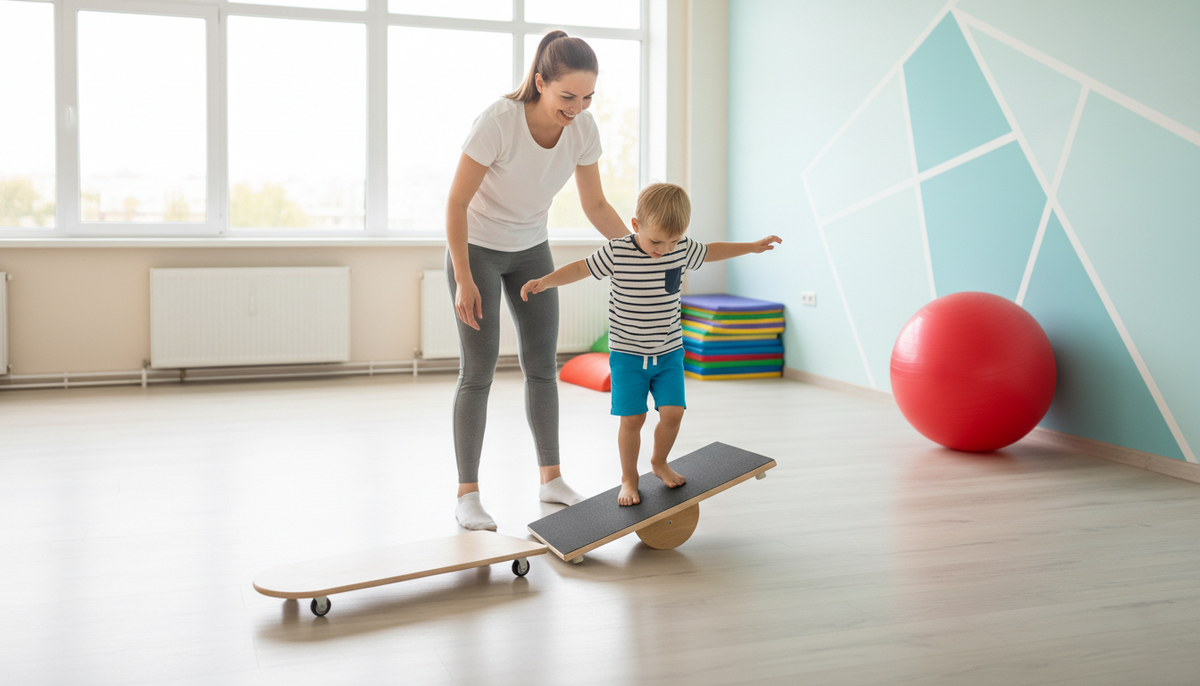
Many cognitive, attention and learning skills are built on motor development, so difficulties in these areas are best addressed at the level of movement first. During TSMT exercises the child moves both actively and passively in every direction in space. This strongly stimulates the balance system, which in turn supports speech development, attention, memory and spatial orientation.
Individual and group sessions
Individual training: after the assessment, the therapist writes a personalised exercise programme, which the child performs several times a week – at home with a parent or with the therapist. Regular practice several times a week is what makes the therapy intensive, fast and effective.
Group training: led by a therapist and recommended for children who follow instructions well and whose coordination and balance allow them to work independently. Children who find group settings more challenging join small groups, while those who manage more easily join larger groups.
When is it recommended?
Motor development
- Delayed motor development: doesn’t lift the head, dislikes tummy time, rolls over late, skips crawling, struggles to stand up or start walking
- Overly floppy (“rag doll”) or constantly tense muscles, in certain body parts or mixed
- Clumsy, uncoordinated movement, or movement that differs between the two sides of the body
- Frequently trips or falls, tires quickly during physical activity
- Afraid of climbing frames, swings or new types of movement; can’t learn to ride a bike
- Struggles with ball games; dislikes drawing, playdough or building blocks
Sensory processing
- Oversensitivity: strong reactions to mild stimuli (light, sound, touch, clothing labels, tastes, textures, swings, even small heights)
- Undersensitivity: barely reacts to strong stimuli, e.g. doesn’t get dizzy after spinning
Speech and communication
- Delayed speech development, limited vocabulary, incorrect grammar, short sentences
- Communicates by pointing rather than naming objects
- Reluctant to talk, finds it hard to describe experiences
- Whispering or monotone speech, cutting off word endings, speech impediments, stuttering, speaking too fast
Behaviour, attention and emotions
- Overactive or overly passive; can’t stay with one activity, or gets stuck on one
- Impulsive, impatient, aggressive; hard to guide, struggles to fit in
- Aimless play, disrupts other children’s games, or is overly shy
- Low self-confidence, anxiety, restless sleep, frequent tantrums, tics, bedwetting
- Inflexible, finds change difficult; limited eye contact, very narrow interests
Learning and school readiness
- Learning difficulties such as dyslexia, dysgraphia or dyscalculia
- Can’t count to 5 at kindergarten age; struggles to copy patterns or continue sequences
- Colours outside the lines, finds it hard to join dots
- Unsure of directions, left and right, or naming body parts
- No established hand dominance by age 7
Also recommended alongside: autism spectrum disorder, ADHD, attention deficit, delayed motor and speech development, specific learning difficulties, cerebral palsy, regulation disorders, sensory processing disorder (SPD) and behavioural problems.
What are the benefits of TSMT?
- More organised, harmonious movement
- Better balance and coordination
- Speech development begins or improves
- Better concentration and attention
- Hand-eye coordination and fine motor skills
- Development of body awareness and spatial orientation
- Self-control and understanding of rules
- Better cooperation and responsiveness
- Positive change in social relationships
- Improved learning processes
How does the therapy work?
- Assessment – the therapist examines the child’s movement and development. Where appropriate, an individual exercise programme is created.
- Instruction – we learn and practise the programme together with the parent and child.
- Home training – parent and child perform the personalised exercises regularly at home.
- Follow-up – after 2–3 weeks you come back and we discuss your experiences. A further follow-up is needed within two months of the initial instruction.
Important information for parents
TSMT requires serious commitment from the parent and cooperation from the child. In return, it greatly strengthens the parent-child bond: the shared exercise time is the child’s very own – especially valuable in families where several siblings compete for attention.